


Advanced Air Mobility is quickly moving from concept to conversation. What was once limited to pilot programs and forward-looking studies is now showing up in airport strategies, regional transportation plans, and real investment discussions. Aircraft are advancing, operators are forming partnerships, and agencies are starting to consider how this new mode of transportation could fit into their broader mobility network.
But before airports move too far down the path of infrastructure planning or formal partnerships, there is a more fundamental question that needs to be answered: where will these services actually work?
That question goes beyond airspace or site feasibility. It gets to the core of demand. Not every airport, corridor, or region will support electric vertical takeoff and landing (eVTOL) aircraft in the same way, and early success will depend on identifying the markets where the value proposition is clear. Understanding where people are traveling, what problems they are trying to solve, and how eVTOL fits into that equation is what determines whether these services move from concept into something that is used, sustained, and scaled.
What problem are we trying to solve?
When we talk about eVTOLs, the conversation often starts with the aircraft itself. Vertical takeoff and landing. Electric propulsion. Faster travel times. That context matters, but technology alone does not create a market.
The real question is what problems eVTOLs are solving. In some cases, it is about providing another transportation option that provides time savings between a downtown and a major airport. In others, it is about improving regional connectivity or enabling faster movement of time-sensitive goods. Each of these leads to a different outcome in terms of where and how eVTOL operations should be introduced.
| “Technology does not create demand. Markets do.” |
Start with the market, not the technology.
A useful way to frame early eVTOL planning effort is by focusing on two core questions: what services are being offered, and where those services are connecting.
These variables can be adjusted and evaluated. A passenger route between two airports may appear promising, but pricing could limit demand. A cargo-focused operation may succeed with an entirely different infrastructure footprint.
Understanding those tradeoffs early is what defines a viable market.
| “Defining the market comes down to aligning the right use case with the right destinations.” |
What makes a strong market?
Three factors consistently shape early eVTOL opportunities.
The first is travel frequency. Demand starts with movement, and corridors with a high number of daily trips provide the strongest foundation for a new mobility option. This can be understood through a mix of traffic data, mobile device insights, airport trip patterns, and TNC usage. Conversely, remote options may also be viable, so while travel frequency matters, it is equally important to understand how people move between locations.
The second is household income. eVTOL services are not expected to compete as the lowest-cost option within an existing transportation landscape. Instead, they compete on time savings, which means markets with higher household incomes tend to show stronger potential for early adoption.
The third is how pricing fits within the broader transportation landscape. eVTOL does not need to be the cheapest option, but it needs to make sense relative to alternatives. The balance between cost and time savings determines whether a route could be viable.
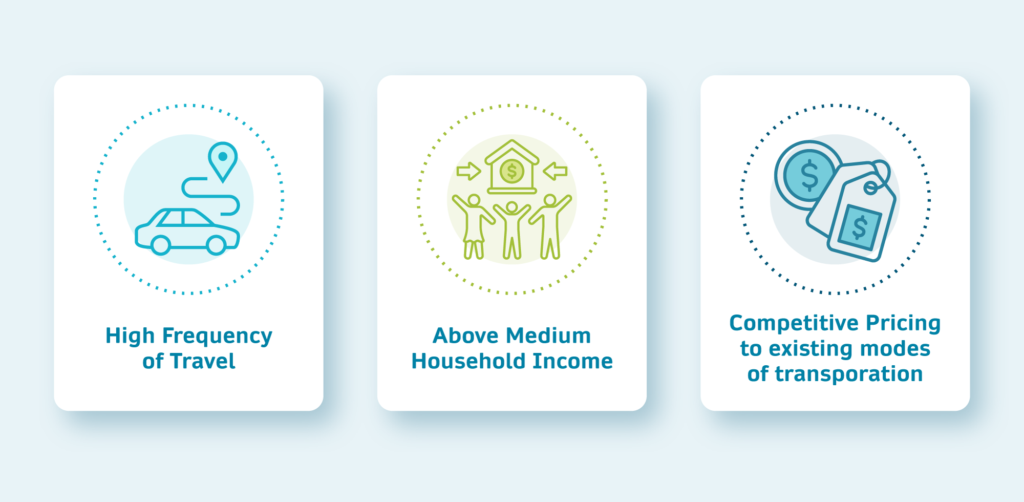
What makes a strong market?
When these elements are brought together, they start to move the conversation from broad opportunity to specific, actionable insight. Instead of asking where eVTOLs could operate, the focus shifts to where they should operate based on real travel behavior, pricing sensitivity, and corridor demand. Patterns begin to emerge around priority routes, user groups, and the types of services that are most likely to gain traction early.
At that point, planning begins to move from concept to application. Airports and their partners can start to define a realistic network, identifying initial corridors that balance demand, distance, and operational feasibility. That clarity allows for more informed decisions around vertiport locations, facility sizing, passenger processing, and landside connections. It also provides a framework for engaging operators, aligning with local jurisdictions, and coordinating with regional transportation systems.
Just as important, this level of definition strengthens the business case. Demand estimates become more grounded, revenue potential can be assessed against different pricing scenarios, and capital investments can be phased to match market maturity. Rather than building for a future that may or may not materialize, airports can take a measured approach, aligning infrastructure and operations with demonstrated demand. That is what bridges the gap between early exploration and a viable, investable strategy.
Planning eVTOL Starts with the Market
Integrating eVTOL operations is not a plug-and-play exercise. It asks airports to think differently about how infrastructure is planned, how operations are managed, and how users move through the system. That includes everything from where vertiports should be located, to how they connect with terminals and ground transportation, to how airspace and flight procedures are structured to safely accommodate a new class of aircraft. It also requires coordination beyond the airport fence, bringing in local jurisdictions, transportation agencies, and private operators to align on how these services will function day to day.
But none of those decisions should happen in a vacuum.
They need to be grounded in a clear understanding of the market. Where are people traveling today? What trips are they trying to make faster or more dependable? What are they willing to pay for that time savings? Without those answers, it is easy to overbuild, misplace infrastructure, or invest in services that never gain traction.
Airports that take a data-driven approach early can start to answer those questions with confidence. By combining travel patterns, demographic insights, and pricing sensitivity, they can identify the right use cases, define realistic service areas, and prioritize investments that have a path to demand. That shift, from planning around what is possible to planning around what is viable, is what moves eVTOL from concept to implementation.
Related Insights
Contact Us
Ready to get started? Let’s work together on finding solutions that work for you. Get in touch and let us know how we can help!
Contact Us